 Press.disney.co.uk

Secrets of the Whales Episode 102: Humpback Song
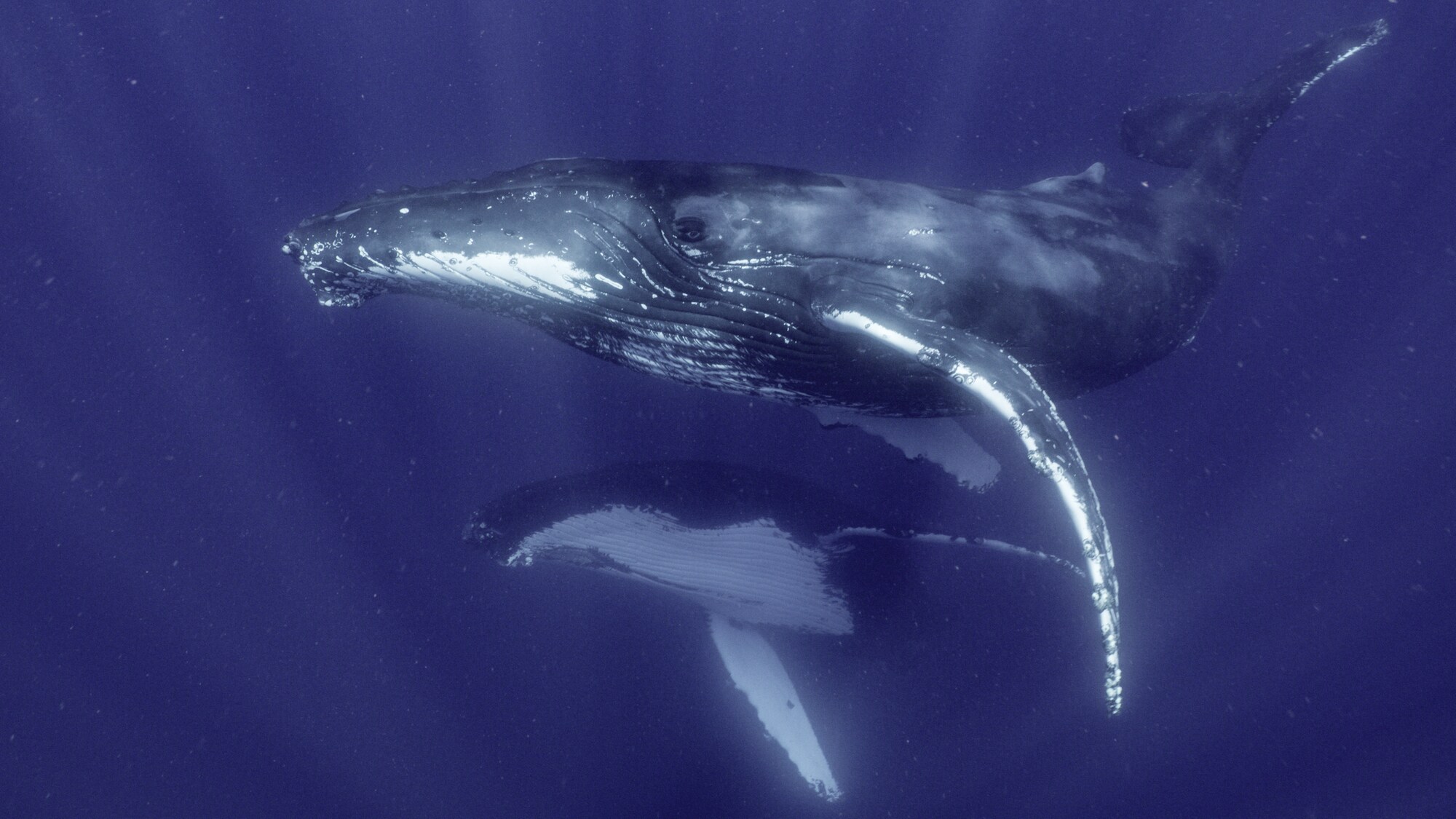
In a classroom that spans the world’s oceans, from Alaska’s herring-rich coastline to Antarctica’s feeding grounds, humpback calves learn their family’s traditions. Cooperative hunting strategies, the longest migrations of any known mammal and communicating through complex songs to find a mate are all lessons absorbed by the younger generation.
To download high-res images, click on the image and then use the Download button in the overlay that appears.




Underwater cinematographer Adam Geiger prepares to dive with humpback whales. (National Geographic for Disney+/Brian Armstrong)
1 of 19Antarctic icebergs dwarfed the team's expedition vessel, The Australis, while the team filmed humpbacks at the bottom of the world. (National Geographic for Disney+/Hayes Baxley)
2 of 19Antarctic icebergs dwarfed the team's expedition vessel, The Australis, while the team filmed humpbacks at the bottom of the world. (National Geographic for Disney+/Hayes Baxley)
3 of 19Writer/Director Brian Armstrong led the 45-day Planet of the Whales expedition to Antarctica. (National Geographic for Disney+/Hayes Baxley)
4 of 19One obstacle stands between South America and the Antarctic Peninsula: the infamous Drake's Passage. The Planet of the Whales team referred to the sea conditions as "being stuck inside a washing machine." (National Geographic for Disney+/Hayes Baxley)
5 of 19Director of Photography Hayes Baxley rests aboard The Australis expedition vessel in Antarctica. The Planet of the Whales team filmed for 45 days at the bottom of the world. (National Geographic for Disney+)
6 of 19The Cook Islands are as remote as it gets - a group of volcanic islands surrounded by the Pacific Ocean, and an important stop for migrating humpbacks. (National Geographic for Disney+/Hayes Baxley)
7 of 19A humpback whale shows its fluke before a deep dive underneath one of Antarctica's icebergs. (National Geographic for Disney+/Hayes Baxley)
8 of 19Whales are oceanic mammals - they need air to breathe, and they do so through a strategically positioned blowhole at the top of their heads. The force of an exhale is great, sending water 15 feet up at an impressive 300 miles per hour. (National Geographic for Disney+/Hayes Baxley)
9 of 19Humpback whales undergo one of the longest migrations of any mammal on Earth - over 6,000 miles. (National Geographic for Disney+/Adam Geiger)
10 of 19Humpback whales undergo one of the longest migrations of any mammal on Earth - over 6,000 miles. (National Geographic for Disney+/Adam Geiger)
11 of 19Scientists believe humpbacks breach to communicate to other whales - although it also looks like fun. (National Geographic for Disney+/Hayes Baxley)
12 of 19Scientists believe humpbacks breach to communicate to other whales - although it also looks like fun. (National Geographic for Disney+/Hayes Baxley)
13 of 19Humpback whale calves are born more than 10 feet long. (National Geographic for Disney+/Adam Geiger)
14 of 19The humpback's tail - called a fluke - has patterns as unique as a human fingerprint. Scientists use them to identify individuals year after year. (National Geographic for Disney+/Hayes Baxley)
15 of 19The humpback's tail - called a fluke - has patterns as unique as a human fingerprint. Scientists use them to identify individuals year after year. (National Geographic for Disney+/Hayes Baxley)
16 of 19Only male humpbacks sing their famous songs - perhaps to attract a willing mate. (National Geographic for Disney+/Adam Geiger)
17 of 19Humpbacks and other whales "spyhop," where they stick their heads out of the water. It may be to get a better view - or listen in - to action at the surface. (National Geographic for Disney+/Brian Armstrong)
18 of 19A group of humpbacks approach biologist Nan Hauser and National Geographic photographer Brian Skerry while on assignment for Planet of the Whales. (National Geographic for Disney+/Hayes Baxley)
19 of 19All images ©Disney. Editorial use only.